
Executive Summary
In a rigorous field test conducted with Transportes Azteca, the 360ES-PEM system demonstrated a verified fuel efficiency increase of 16.36% to 20.7% under severe service conditions.
Client
Transportes Azteca
Vehicle
Unit 333 - Freightliner Cascadia (2023)
Engine
Cummins X15 (Efficiency Series)
Technology
360ES-PEM-15L
The Challenge: 'Severe Service' Conditions
The objective was to validate performance in a high-stress environment where standard diesel efficiency typically collapses.
- Extreme Load (Edible Oil Tankers): Double-tanker configuration with 65-Ton gross towed weight.
- Operational Cycle: Average speed of 28 km/h creates 'Ghost Mileage', penalizing economy.
- The Baseline: Under these conditions, the baseline drops to 1.06 - 1.10 km/L.
The Solution: 360ES-PEM Integration
360 Energy Solutions installed the 360ES-PEM-15L onboard hydrogen generation system. The unit features a micro-computer calibrated to the specific fuel map of the Cummins X15 ECU, injecting a precise dosage of H2+O2 to accelerate the front flame and ensure complete combustion.
Key Results (Validated Telemetry)
Phase 1: Maximum Potential (Empty)
After firmware updates and calibration, the unit was tested without a payload to verify stoichiometric balance.
Result: 2.95 km/L (33.9 L/100km) over 500 km.
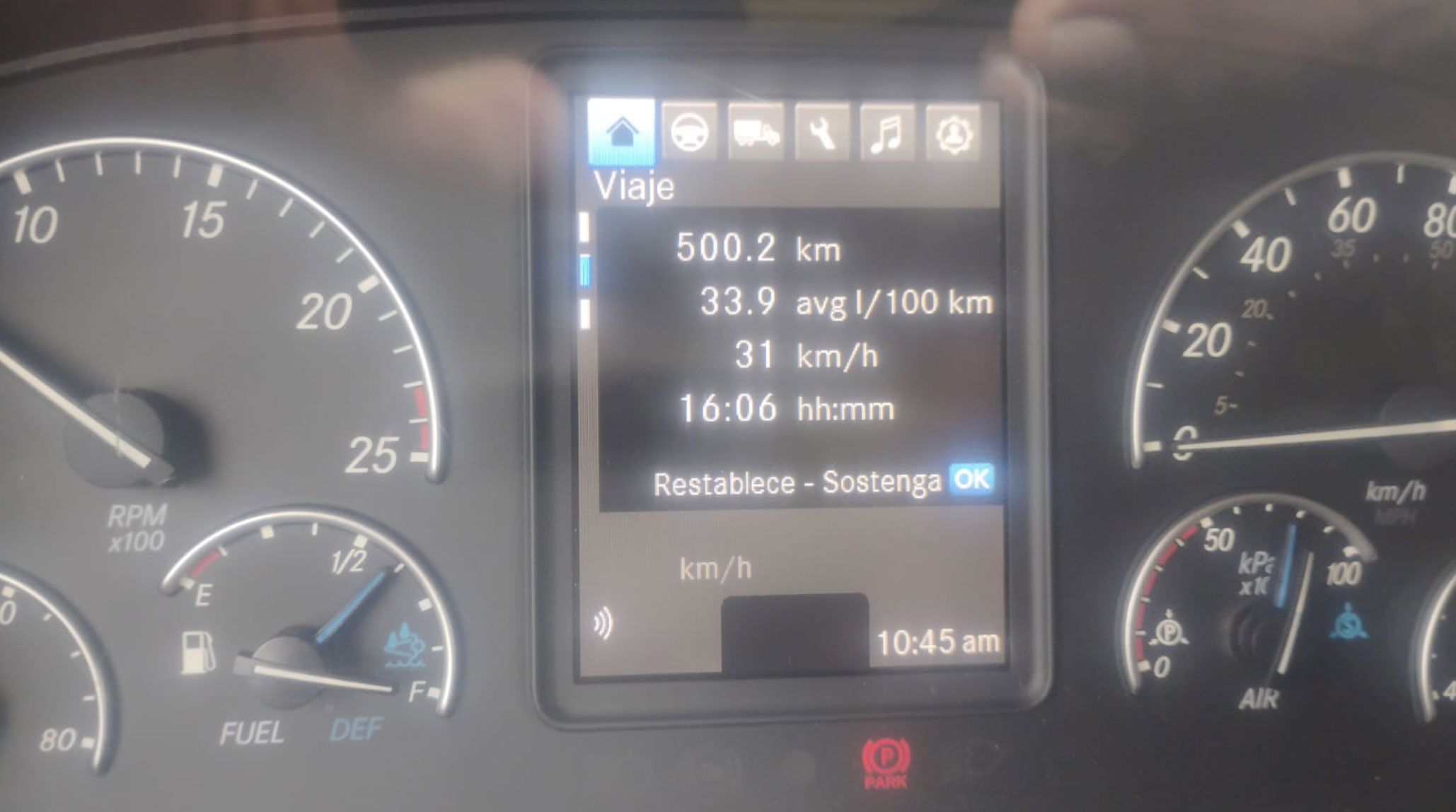
Phase 2: The 'Stress Test' (65 Tons / 28 km/h)
This phase measured real-world performance under maximum load.
| Metric | Industry Standard (Baseline) | With 360ES-PEM | Improvement |
|---|---|---|---|
| Fuel Economy | 1.10 km/L | 1.28 km/L | +16.36% Efficiency |
| Consumption | 90.9 L/100km | 78.0 L/100km | -14.2% Fuel Volume |
Engineering Note: If compared against the calculated “Severe Traffic” baseline of 1.06 km/L, the net efficiency improvement rises to 20.75%.
Conclusion
The 360ES-PEM system successfully validated its ability to maintain torque and efficiency in scenarios where diesel engines typically struggle. Achieving a sustained 1.28 km/L with 65 Tons of payload is a major engineering extension, proving the technology is not just a fuel saver, but a heavy-duty torque enhancer.

Consumer Field Test
A 55% efficiency gain on a Range Rover Sport.
Read Consumer Test
Commercial (Diesel)
20% efficiency gains on a Volvo DD 9800.
Read Commercial Test
Commercial CNG Test
20-30% efficiency gains on a Shacman X3000.
Read CNG Test